As one of the most popular home-stay platforms today, Airbnb’s digital business model can be called the model of the industry. Its leading sharing economy and e-business model are the reasons why it is so successful, and based on the use of digital technology, Airbnb provides both the customers and landlords with high-quality services and experiences.

Based on adopting the business model of sharing economy which has become popular in recent years (Gansky, 2010), Airbnb meets the needs of landlords and tourists through digital markets (Botsman and Rogers, 2011) by providing a personalized experience between both of them (Guttentag, 2015). Sharing economy is a sustainable economic system built with the sharing of private properties. This whole new business model greatly relies on P2P technology to empower individuals and other organizations with methods of sharing excess capacity in tangible and intangible assets (Zekanovic-Korona, 2014). Moreover, based on the development of mobile digital platforms, the scale of the sharing economy which is based on the recycling economy has expanded infinitely. For example, by using a mobile digital platform, Airbnb has increased the efficiency of marketing and user operations, since most people nowadays gather their information online and it is easier to schedule their own time. What is more, Airbnb uses the P2P business communication model through the digital platform, which not only enables customers to have customized services but also enables landlords to save the cost of hiring service personnel.

Also, the transparency of digital platforms makes every user’s comment on a tool that can be used to monitor service quality, increasing trust in the sharing economy between customers and homeowners. Finally, sharing economy is based on the circular economy, which advocates sustainable development, and the use of Internet digital technology successfully reflects Airbnb’s attitude to the effective use of resources.

As one of the best examples of Internet commerce, Airbnb’s digital transformation in the traditional hospitality industry is undoubtedly an indispensable factor that makes it big only from an airbed in California to a company with users from all over the world. As a hospitality company based on the use of e-business model, Airbnb does not own one single hotel room of its own because it only uses the network to provide a platform for leasing business, hence it reduces the construction costs that are required by the traditional hotel business. Besides, by using e-business model, Airbnb has its database all over the world. This database uses real-time mobile technology to process data and then transfer it to Airbnb’s cloud for further analysis. This makes it possible to analyse market conditions and user data at any time for the recommendation of most suitable home-stay for them, and users can also search for places by themselves in real-time, no matter when and where. Also, Airbnb will send a notification email to the users who haven’t booked their saved order yet or the ones who take some time doing the research but quit at some point as a reminder to their trip or unfinished orders, and this is all done by the data analyse system. Moreover, the landlord attributes and room leasing information are displayed on Airbnb to help tourists to evaluate the listings and choose rental places more effectively (Ert et al., 2016) and they can have a conversation directly. Therefore, it is beyond doubt that Airbnb can attract so many users at an affordable price without being restricted by traditional working hours
Last but not least, Airbnb’s strong competitiveness is also an essential reason for its success. In my opinion, the most competitive advantage of Airbnb compared with other hospitality industries is its pricing advantage. As a product of the digital sharing economy, it saves the cost of service personnel, rent and many operating costs. Also, it is an idle house leasing business, and the cost is not as much, so its price is lower than other hotel industries. Pricing is widely considered to be one of the most essential factors determining the long-term success of the accommodation industry (Hung et al., 2010), Airbnb homeowners can easily change the price of their own house according to the peer pricing on their mobile phones (Wang, 2017). Hence, more people are willing to start their own home rental business at Airbnb, and there is a growing number of users as well.
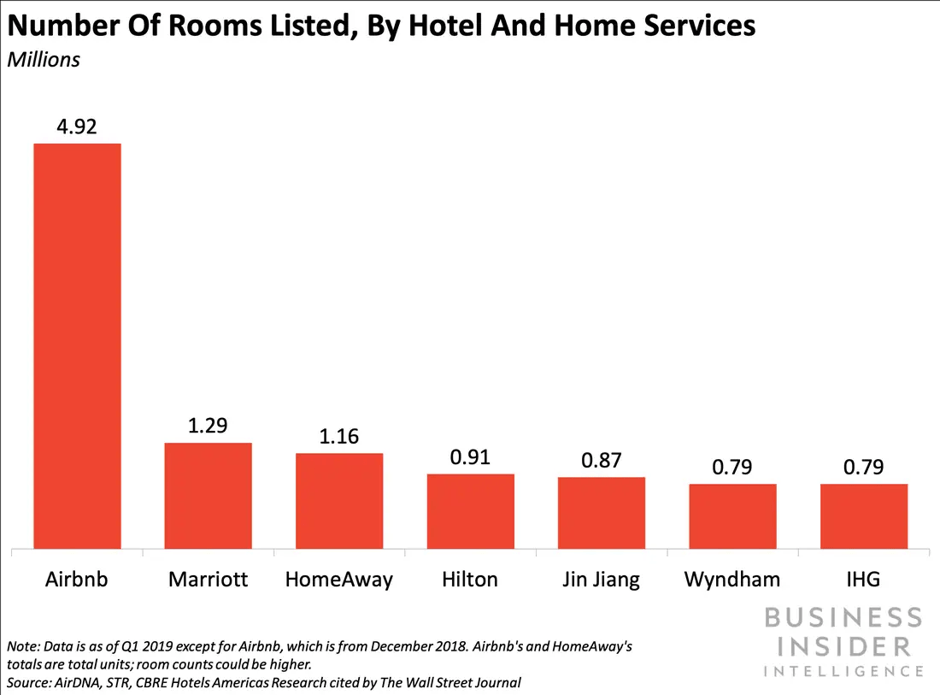
Digital model business enables Airbnb to create a new business model of the hospitality industry, eliminating the obstacles in the traditional hotel business market, and become what it is today.
Reference
Campione. K. (2019). Airbnb to recreate trip from ‘Around the World in 80 Days’. Retrieved from https://abcnews.go.com/Lifestyle/wireStory/airbnb-recreate-trip-world-80-days-63683541
Ert, E., Fleischer, A. and Magen, N. (2016), “Trust and reputation in the sharing economy: the role of personal photos in Airbnb”, Tourism Management, Vol. 55, pp. 62-73.
Guttentag, D. (2015), “Airbnb: disruptive innovation and the rise of an informal tourism accommodation sector”, Current Issues in Tourism, Vol. 18 No. 12, pp. 1192-1217.
Keyes. D. (2019). Marriott is challenging Airbnb with its own home rental offering. Retrieved from https://www.businessinsider.com/marriott-launches-home-rentals-battling-airbnb-2019-5?r=US&IR=T
L. Gansky. (2010). The Mesh: Why the Future of Business is Sharing Portfolio Penguin, New York, NY.
Matofska. B. (2018). The best place for women is in the sharing economy. Retrieved from https://www.benitamatofska.com/single-post/2018/03/06/THE-BEST-PLACE-FOR-WOMEN-IS-IN-THE-SHARING-ECONOMY
Papineau. D. (2018). “How to Boost your Income by Becoming an Airbnb Co-Host? “. Retrieved from https://www.airbnbsecrets.com/airbnb-co-host/
R. Botsman, R. Rogers. (2010). What’s Mine is Yours: The Rise of Collaborative Consumption HarperCollins, New York, NY.
Wang, D., & Nicolau, J. L. (2017). Price determinants of sharing economy based accommodation rental: A study of listings from 33 cities on Airbnb. com. International Journal of Hospitality Management, 62, 120-131.
W.T. Hung, J.K. Shang, F.C. Wang, Pricing determinants in the hotel industry: quantile regression analysis, Int. J. Hosp. Manag., 29 (3) (2010), pp. 378-384
Zekanovic-Korona, L., & Grzunov, J. (2014). Evaluation of shared digital economy adoption: Case of Airbnb. In 2014 37th International Convention on Information and Communication Technology, Electronics and Microelectronics (MIPRO) (pp. 1574-1579). IEEE.
 Lisa's Blog