分类
未分类

This is not the end, BEMM129!

As the term is coming to an end, so is the course BEMM129. However, going through the course with a dialectical attitude. Not only did I learn so much knowledge from this course, but I am going to apply it to my future life, so the influence of this course on me will be continued. To transfer knowledge into experience, according to Atkins and Murphy (1993), reflection in a learning environment can help people actively explore their experiences to gain new experiences and understandings (Atkins, 1993). Therefore, I’m using the Atkins and Murphy model since it can be used to explicitly support a deeper reflection (The Open University, 2019).

1. Identify any learning

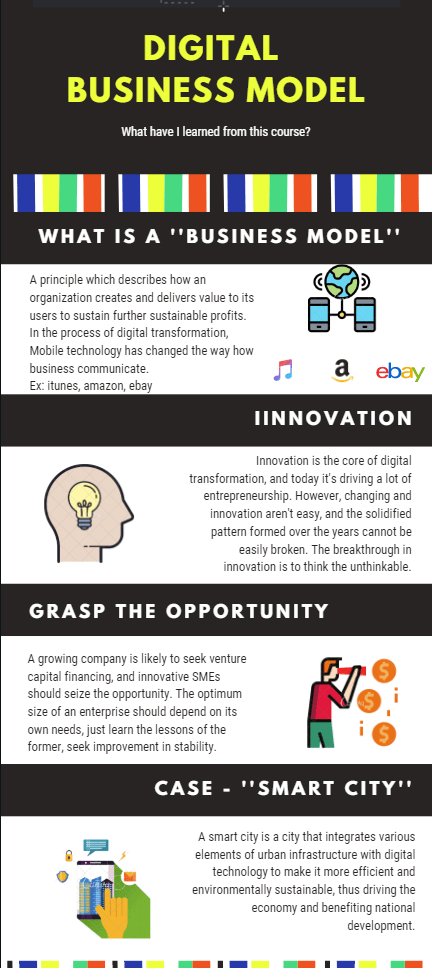
This course analyses the effects of digitization on its various aspects and their interrelationships from a business standpoint, as well as a series of derivatives. Business models are principles that describe how an organization creates and delivers value to its users to sustain further sustainable profits (Osterwalder, 2002). The digital transformation has stimulated innovation and provided more opportunities for companies.
2. Awareness

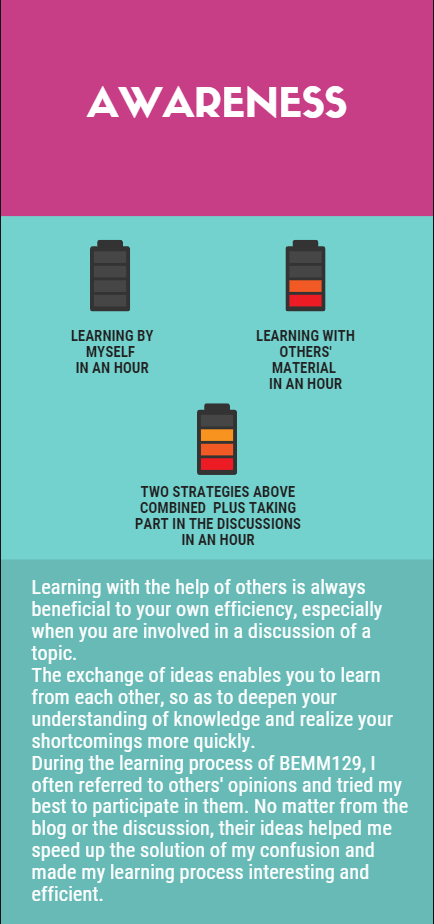
I check the weekly discussion or other people’s blog to assist my study and enhance my understanding.

Although the rapid development of digital business models has accelerated the development of various industries, the speed of legislation has not kept pace with it. This leads to problems like privacy disclosure and fraud, the moral standards of the digital world are still fuzzy.
3. Describe the situation

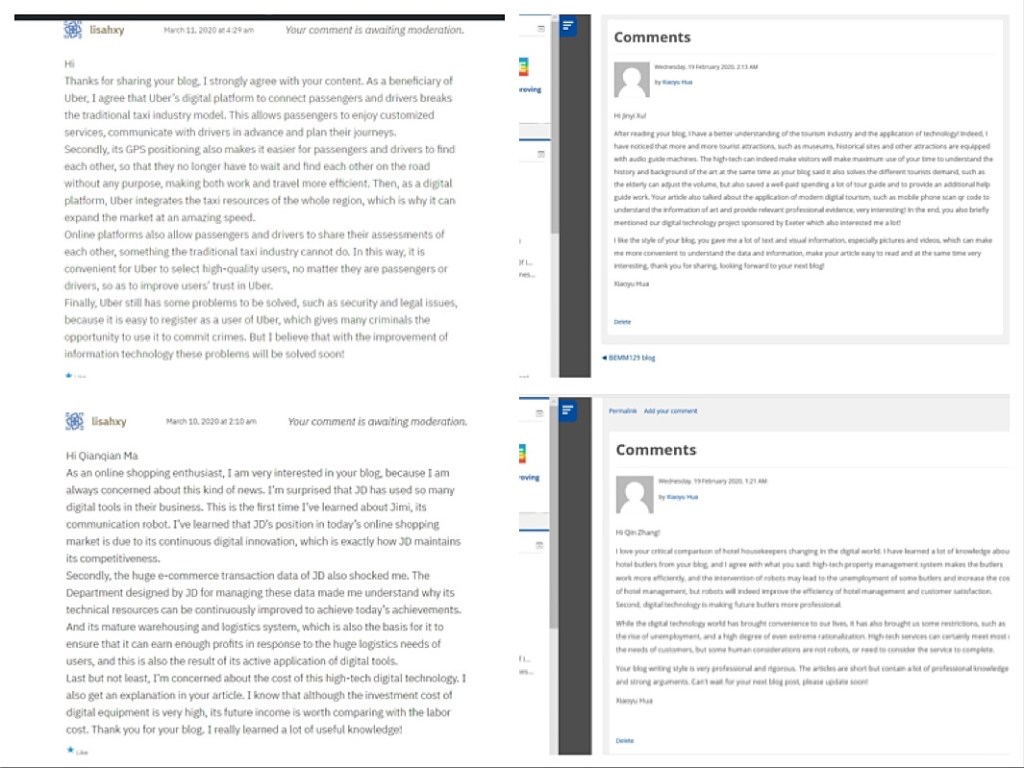
Here are some very interesting blog posts that I’ve been involved with, having a discussion with others and sharing different ideas are just so fun and useful! (The links to their blogs will be in the reference list)

Continuing discussing with me here after reading their articles and my comments are welcomed!
4. Analyse feeling and knowledge

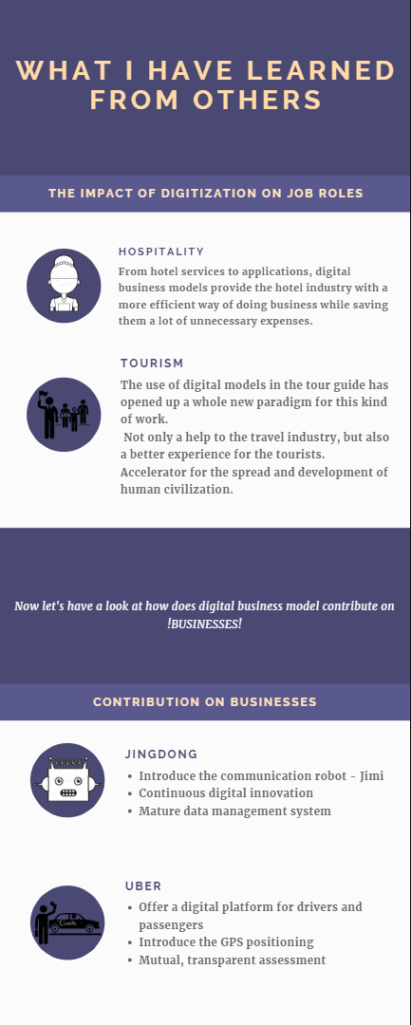
From these four amazing blog posts, I have gained knowledge in different ways of how digital business models have changed the traditional development model, these successful cases have all overturned the traditional model of their industry through innovative application of digital models.
5. Evaluate the relevance of knowledge

Digital technology is not only applicable in the field of high-end technology, but also can be combined with anything in life, and people are gradually inseparable from it. In this context, the use of a good digital business model can certainly accelerate the development of enterprises, but it should not neglect its focus on innovation, sustainable development and legal provisions, no company can go far with the absence of one of these.

Reference

Atkins, S., & Murphy, K. (1993). Reflection: a review of the literature. Journal of advanced nursing18(8), 1188-1192.

Osterwalder, A., & Pigneur, Y. (2002). An eBusiness model ontology for modeling eBusiness. BLED 2002 proceedings, 2.

The Open University (2019). Learning to teach: becoming a reflective practitioner. Retrieved from https://books.google.co.uk/books?id=bu0kDwAAQBAJ&pg=PA1&lpg=PA1&dq=boud%27s+triangular+representation&source=bl&ots=bgoCJPE_zQ&sig=ACfU3U3ZVgYQirh20nzUjV1MKBelltxGaw&hl=zh-CN&sa=X&ved=2ahUKEwi5n7mauLLoAhWYh1wKHW5pBocQ6AEwDXoECAsQAQ#v=onepage&q=boud’s%20triangular%20representation&f=false

Housekeeper and digital business – Qin Zhang

https://zhangqinteresa.wordpress.com/2020/02/14/housekeeper-and-digital-business/

JingDong’s Digital Development—Use of Robots and Automation Technologies – Qianqian Ma

https://qianqiandigitalbusiness.wordpress.com/2020/03/05/jingdongs-digital-development-use-of-robots-and-automation-technologies/

Traditional tour guide and tour guide robots – Jinyi Xu

https://wordpress.com/read/feeds/102979161/posts/2586075430

How the digital business model contributed to Uber’s success – Tingyu

分类
未分类

Evaluating the role of the digital business model for Airbnb

As one of the most popular home-stay platforms today, Airbnb’s digital business model can be called the model of the industry. Its leading sharing economy and e-business model are the reasons why it is so successful, and based on the use of digital technology, Airbnb provides both the customers and landlords with high-quality services and experiences.

(Campione, 2019)

Based on adopting the business model of sharing economy which has become popular in recent years (Gansky, 2010), Airbnb meets the needs of landlords and tourists through digital markets (Botsman and Rogers, 2011) by providing a personalized experience between both of them (Guttentag, 2015). Sharing economy is a sustainable economic system built with the sharing of private properties. This whole new business model greatly relies on P2P technology to empower individuals and other organizations with methods of sharing excess capacity in tangible and intangible assets (Zekanovic-Korona, 2014). Moreover, based on the development of mobile digital platforms, the scale of the sharing economy which is based on the recycling economy has expanded infinitely. For example, by using a mobile digital platform, Airbnb has increased the efficiency of marketing and user operations, since most people nowadays gather their information online and it is easier to schedule their own time. What is more, Airbnb uses the P2P business communication model through the digital platform, which not only enables customers to have customized services but also enables landlords to save the cost of hiring service personnel.

(Papineau, 2018)

Also, the transparency of digital platforms makes every user’s comment on a tool that can be used to monitor service quality, increasing trust in the sharing economy between customers and homeowners. Finally, sharing economy is based on the circular economy, which advocates sustainable development, and the use of Internet digital technology successfully reflects Airbnb’s attitude to the effective use of resources.

(Matofska, 2018)

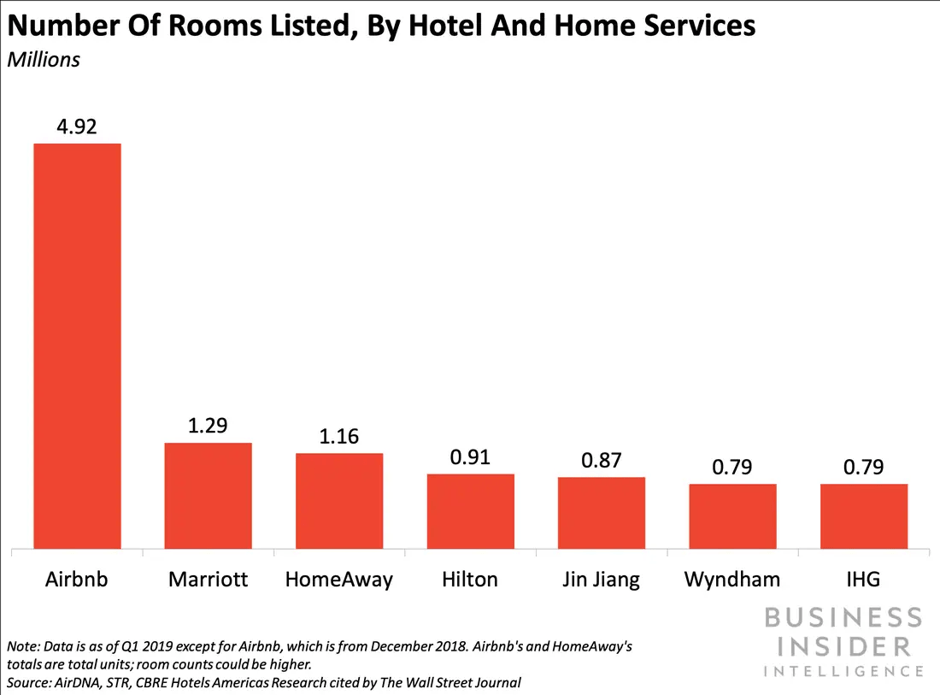
As one of the best examples of Internet commerce, Airbnb’s digital transformation in the traditional hospitality industry is undoubtedly an indispensable factor that makes it big only from an airbed in California to a company with users from all over the world. As a hospitality company based on the use of e-business model, Airbnb does not own one single hotel room of its own because it only uses the network to provide a platform for leasing business, hence it reduces the construction costs that are required by the traditional hotel business. Besides, by using e-business model, Airbnb has its database all over the world. This database uses real-time mobile technology to process data and then transfer it to Airbnb’s cloud for further analysis. This makes it possible to analyse market conditions and user data at any time for the recommendation of most suitable home-stay for them, and users can also search for places by themselves in real-time, no matter when and where. Also, Airbnb will send a notification email to the users who haven’t booked their saved order yet or the ones who take some time doing the research but quit at some point as a reminder to their trip or unfinished orders, and this is all done by the data analyse system. Moreover, the landlord attributes and room leasing information are displayed on Airbnb to help tourists to evaluate the listings and choose rental places more effectively (Ert et al., 2016) and they can have a conversation directly. Therefore, it is beyond doubt that Airbnb can attract so many users at an affordable price without being restricted by traditional working hours

Last but not least, Airbnb’s strong competitiveness is also an essential reason for its success. In my opinion, the most competitive advantage of Airbnb compared with other hospitality industries is its pricing advantage. As a product of the digital sharing economy, it saves the cost of service personnel, rent and many operating costs. Also, it is an idle house leasing business, and the cost is not as much, so its price is lower than other hotel industries. Pricing is widely considered to be one of the most essential factors determining the long-term success of the accommodation industry (Hung et al., 2010), Airbnb homeowners can easily change the price of their own house according to the peer pricing on their mobile phones (Wang, 2017). Hence, more people are willing to start their own home rental business at Airbnb, and there is a growing number of users as well.

(Keyes, 2019)

Digital model business enables Airbnb to create a new business model of the hospitality industry, eliminating the obstacles in the traditional hotel business market, and become what it is today.

Reference

Campione. K. (2019). Airbnb to recreate trip from ‘Around the World in 80 Days’. Retrieved from https://abcnews.go.com/Lifestyle/wireStory/airbnb-recreate-trip-world-80-days-63683541

Ert, E., Fleischer, A. and Magen, N. (2016), “Trust and reputation in the sharing economy: the role of personal photos in Airbnb”, Tourism Management, Vol. 55, pp. 62-73.

Guttentag, D. (2015), “Airbnb: disruptive innovation and the rise of an informal tourism accommodation sector”, Current Issues in Tourism, Vol. 18 No. 12, pp. 1192-1217.

Keyes. D. (2019). Marriott is challenging Airbnb with its own home rental offering. Retrieved from https://www.businessinsider.com/marriott-launches-home-rentals-battling-airbnb-2019-5?r=US&IR=T

L. Gansky. (2010). The Mesh: Why the Future of Business is Sharing Portfolio Penguin, New York, NY.

Matofska. B. (2018). The best place for women is in the sharing economy. Retrieved from https://www.benitamatofska.com/single-post/2018/03/06/THE-BEST-PLACE-FOR-WOMEN-IS-IN-THE-SHARING-ECONOMY

Papineau. D. (2018). “How to Boost your Income by Becoming an Airbnb Co-Host? “. Retrieved from https://www.airbnbsecrets.com/airbnb-co-host/

R. Botsman, R. Rogers. (2010). What’s Mine is Yours: The Rise of Collaborative Consumption HarperCollins, New York, NY.

Wang, D., & Nicolau, J. L. (2017). Price determinants of sharing economy based accommodation rental: A study of listings from 33 cities on Airbnb. com. International Journal of Hospitality Management, 62, 120-131.

W.T. Hung, J.K. Shang, F.C. Wang, Pricing determinants in the hotel industry: quantile regression analysis, Int. J. Hosp. Manag., 29 (3) (2010), pp. 378-384

Zekanovic-Korona, L., & Grzunov, J. (2014). Evaluation of shared digital economy adoption: Case of Airbnb. In 2014 37th International Convention on Information and Communication Technology, Electronics and Microelectronics (MIPRO) (pp. 1574-1579). IEEE.

分类
未分类

Lisa’s blog

Accountant in digital world

From what I have seen and experienced, being an accountant in the digital world now is not what it was back in the paper-using era, the main role of accountants has changed nowadays and will keep changing in the future as well.

Artificial Intelligence In Accounting And Finance
(Marr, 2019)


The job role of being an accountant has changed in many ways. For example, due to the influence of electronic economy, distance is no longer an issue for the accounting profession. Every capital record will be timely transmitted to the accountant through network, which makes the accountant’s work more efficient, but also highly requires the accountant to operate digital technology professionally because distance doesn’t just simply disappear, but when you are in a place where the value of the money is influenced immediately by ongoing online transactions happening many miles away, it’s definitely a different situation from how the world was in the past (Giddens, 1999). Also, Digital economy has changed the knowledge of accounting process, practices and thinking (Bhimani, 2003). Before the rise of digital economy, accountants relied on paper, pens and numerical formulas to keep track of their accounts. But today, accountants can use digital electronic systems to operate and use formulas to calculate funds and accounts, and access information about the flow of funds through the Internet, which also requires them to be able to operate professional electronic accounting systems and procedures, even accounting formulas are very different from what they used to do on the calculators. What is more, the role of accountants is no longer just a simple financial recorder in the digital economy market nowadays. They have been been developed to evaluate the company’s future capital development and even play a decision-making role. The web-enabled accounting operations have altered lots of traditional technical contingencies and organizational relationships which exist with firms (Bhimani, 2006). Accountants can audit and analyse the company’s financial situation in time through the accurate value given by the digital market, so they gradually gain more power in the company’s decision-making with the actual data. Even before a future plan is made,accountants will also be used to reference and evaluate the company’s operating condition.
The rise of the digital economy has brought many great changes to the profession of accountants, which have both advantages and disadvantages. The revolutionary changes have indeed enabled accountants to work more efficiently, but at the same time they have also made their work more complicated and can even affect the credibility of their working results due to the fact that they are receiving loads digital resources online, which is not the best place to trust. In the current environment of “digital-age”, accountants are in great demand for their “niche”auditing, accounting, investigative and legal skills, and accounting scams and frauds are perennial (Bhasin, 2015). Therefore, from the perspective of data collection of the changes in the responsibilities of accountants in the digital economy, I personally believe that in the future digital market, the role of accountants will be more modern and digital, and it is not impossible that the traditional artificial accounting methods will even be eliminated by intelligent machines. Because nowadays people have gradually relied on electronic intelligent machine in their daily life. Although it is not perfect and has many flaws, the efficiency it brings to people’s life and work is incomparable with the traditional way. Although the modern digital market has a high demand for accountants’ professionalism, it provides a lot benefits for accountants at the same time as well. Also, the unreliability of the digital economy will be improved with the improvement of the market. After all, the professional errors caused by the traditional accounting methods are more intolerable. Besides, when it comes to the replacement of artificial accountants by digital intelligent machines, I don’t mean that accountants will become completely unemployed because of the digital economy. As mentioned above, the digital economy is now changing traditional accountant’s work practices,and leaders expect accountants to be customer oriented with a broad understanding of their business(Phillips, 2008). Therefore, I think, in the future, the main responsibility of the accountants will be to analyse and audit the data without the company through the financial data of computer intelligent statistics. Their responsibilities will go beyond the simple recording and calculation, more to analyse the meaning behind the cash flow and figure out whether the company or the partners have done every transaction legally and reasonably, they will be more like analysts or judges. What is more, the intelligent system can not do this because the
operating principle of a company or a market is formulated by people, and it will be constantly adjusted and changed with people’s needs, which requires a certain combination of flexibility and professionalism, and a professional accountant will be required to do these works in the rapid development of the digital economy.
Reference
Bhasin, M. L. (2015). An emperical investigation of the relevant skills of forensic accountants: experience of a developing economy. Available at SSRN 2676519.
Bhimani, A. (2003). Digitization and accounting change. A. Bhimani (Ed.) Management Accounting in the Digital Economy, 1-12.
Bhimani, A. (2006). Management accounting and digitization (pp. 69-93). Oxford, UK: Oxford University Press.
Giddens, A. (1999). Risk and responsibility. The modern law review, 62(1), 1-10.

Marr, B. (2019). Artificial Intelligence In Accounting And Finance. Retrieved from https://bernardmarr.com/default.asp?contentID=1929
Phillips, P., & Halliday, S. V. (2008). Marketing/accounting synergy: a discussion of its potential and evidence in e-business planning. Journal of Marketing Management, 24(7-8), 751-770.

分类
未分类

Introduction

Hi, I’m Lisa. I am currently studying MSc International Tourism Management and about to graduate in September so I am looking for job opportunities as well.

I did my undergraduate degree of International Business in China, during that time, my English skills were constantly challenged as the program was taught completely in English and I also gained insight and knowledge in Accounting, Financing, Marketing and Human Resource Management in an international range and have also developed a critical view and way of conducting the business work based on the different domestic environment. 

I also had two working experiences which are HR assistant and administrative clerk. In the HR assistant role, I assisted the working staff in basic HR tasks such as file recording and keeping, evaluating performances and accounting, learned what is involved in the process of recruiting and evaluating employees and understood how to highlight key requirements expected in prospective candidates for a particular job offering. And in the position of administrative clerk I spent time being trained on the framework for dealing with administrative affairs of the company such as adjusting administrative regulations, assisting with management planning and retailing and strengthened my skills in team cooperation and communication and trained my attitude and ability to deal with potential problems and affairs in a way which aligned with company policy.

In my spare time, I love spending my time on photography, video editing and painting. Because these hobbies can make me think more creatively and they are also a good way to memorize what is good in life.

Are we looking for the same thing? Are we interested in the same hobbies? Any suggestions for my career seeking? Please leave your comments down below!

通过 WordPress.com 设计一个这样的站点
从这里开始